35 Company Holiday Party Ideas Employees Actually Want
Key takeaways:
- December Fridays and the acts worth booking are claimed by September. If you are planning in November, you are choosing from what is left.
- Budget per head, not per party. A clear $100-a-head number settles the venue, food and entertainment argument in one meeting.
- Entertainment is what stops a party becoming ninety minutes of people checking their phones near a buffet. It is also the first line most companies cut.
- The party is a work event. SHRM's guidance on alcohol, invitations and trained bartenders is the difference between a good night and an HR file.
Roughly two thirds of companies still hold holiday parties, and a meaningful share are spending less on them than they used to. Challenger, Gray & Christmas surveyed 173 HR and business leaders in November and December 2024, and found 64% planning a celebration, 17% cutting the budget from the year before, and 4.5% going virtual.
Challenger published those figures in its 2024 Holiday Party Survey, which is still the most recent edition. The firm has not released a 2025 holiday party survey.
Which is the real brief for most people reading this: same expectation, smaller number. The 35 company holiday party ideas below are grouped by where the party happens and what it costs, with the detail that decides whether people enjoy it or endure it.
Book Before Labor Day or Take What's Left
Holiday party planning runs on a compressed calendar that almost nobody respects. The first two weeks of December contain three or four viable Fridays, every company in your city wants the same ones, and venues and acts sell them in roughly that order.
Laid out month by month, what is still bookable shrinks in a straight line.
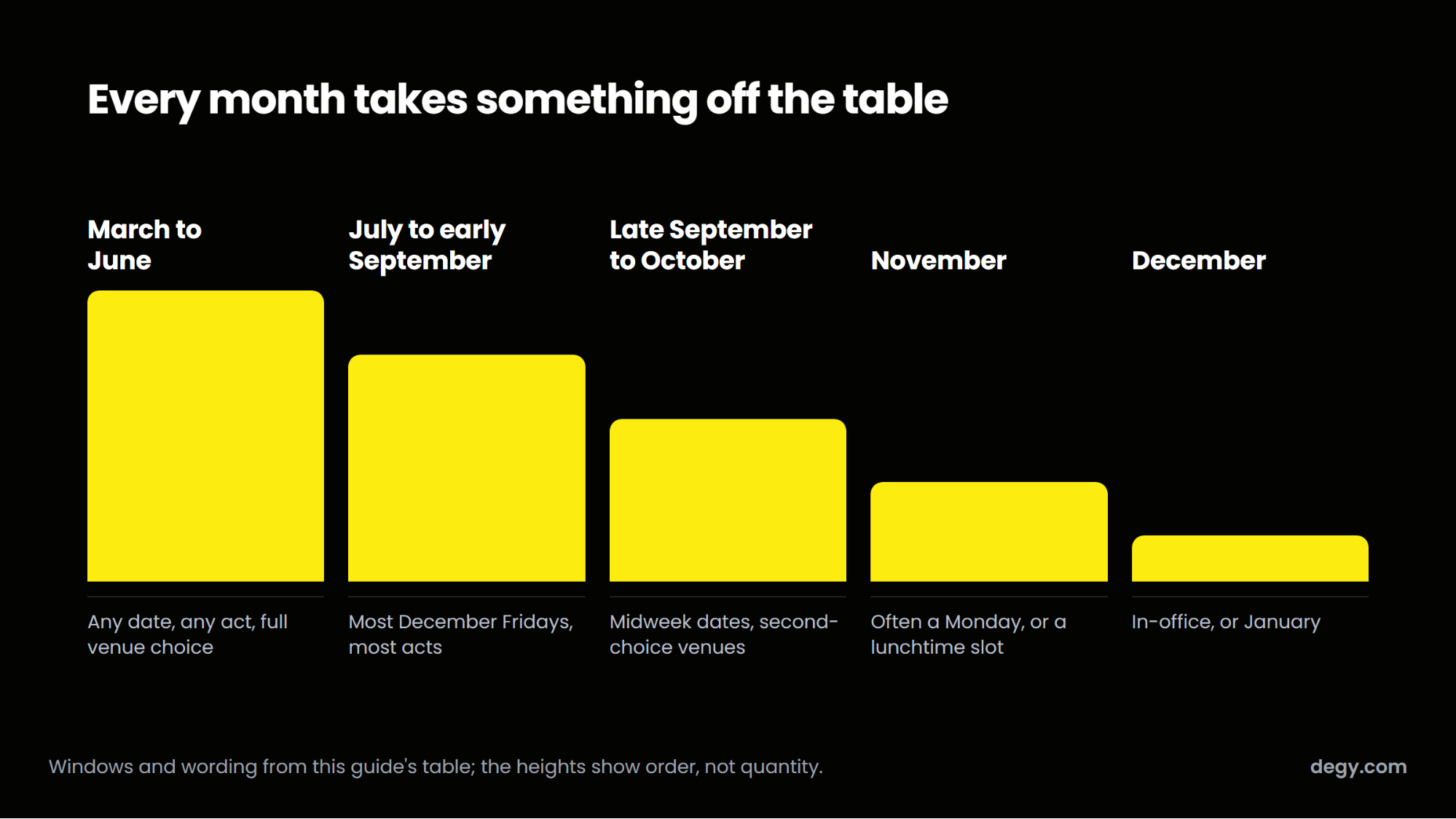
At Degy Entertainment we start taking December holiday bookings in the spring, and by late September the picture is usually set: the strong regional bands are committed, the good private rooms are gone, and what remains is a Tuesday. Booking early is not about getting a better price, it is about having a choice at all.
The other reason to decide early is that the date drives the format. A Tuesday lunch and a Friday evening are different parties with different budgets, and pretending otherwise late in the year is how companies end up with a catered conference room and a disappointed team. How far ahead each type of act has to be locked varies more than most planners expect, which we set out in the booking timeline.
Planning in October or November?
If you are reading this in the fourth quarter, the advice above has already expired and the useful question is what is still genuinely available. Quite a lot is, as long as you stop chasing the format you had in mind in March.
- Take a weekday evening or a lunchtime slot, which is where the remaining venue inventory sits
- Shift the spend from the venue to the entertainment, since an in-office party with a real act beats a mediocre ballroom
- Ask acts about a date they are already routed to, rather than asking them to hold a Friday
- Move the whole thing to January, which is idea 31 below and the strongest option on this page for a late start
The January route is worth taking seriously rather than treating as a defeat: venues are cheaper, the calendar is open, and nobody is competing with you for a Friday. If you want a straight answer about what your date and budget can still buy this year, tell us about your event.
In-Office and Low-Budget Ideas
The office party ideas below work when the budget is genuinely small or the team is too dispersed to travel. The mistake is treating them as a consolation prize; a well-run office party beats a mediocre hotel ballroom comfortably.
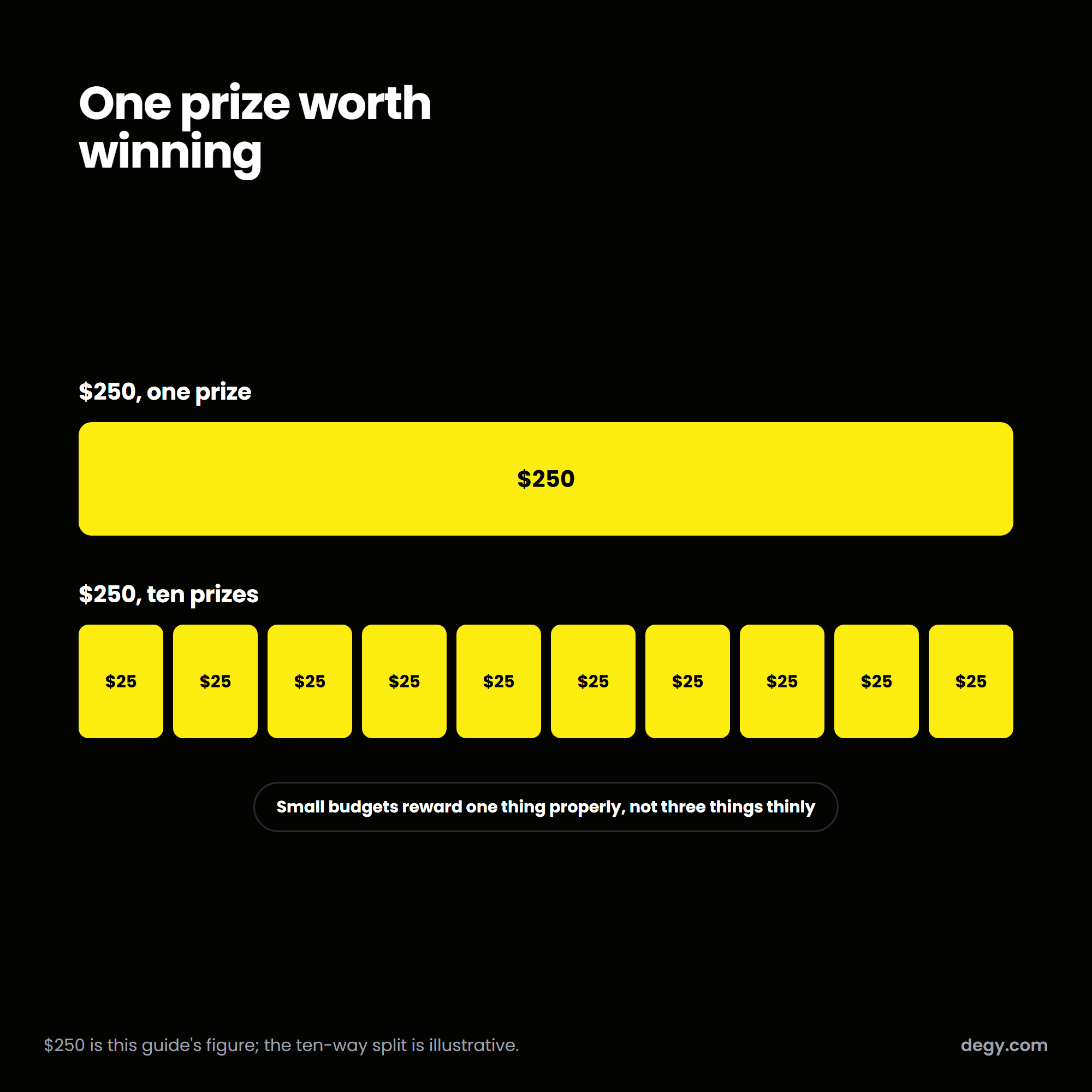
The same money behaves very differently depending on how many pieces it is cut into.
1. Catered lunch with a live acoustic set. A duo in the corner at a sensible volume. Two hours, no dance floor, no bar tab, and people actually talk to each other.
2. Dessert and cocktail hour. Skip dinner entirely. Ninety minutes, a good bartender, a serious dessert table, and everyone is home by seven.
3. Office-wide potluck with a cook-off. Teams enter dishes, a panel judges, a trophy circulates. The cost is prizes and drinks.
4. Holiday breakfast. Underrated and cheap. Pastries, a coffee cart and an hour where nobody is expected to drink anything.
5. Ugly sweater contest with real prizes. It only works if the prize is worth winning. A $250 gift card changes participation completely.
6. Decorating competition by department. Runs over a week, costs almost nothing, and creates the photos that carry your internal comms into January.
7. Gift exchange with a twist. Set a budget, add a rule, and cap the whole thing at thirty minutes. Longer than that and the room drifts.
8. Charity build afternoon. Teams assemble bikes, care packages or toys that go to a local organization. In our experience it tends to land better than a conventional party with teams who would rather be doing something than standing around.
Small budgets reward spending on one thing properly rather than three things thinly, which is the argument we make for stretching a small budget.
Off-Site Venue Ideas
Leaving the office signals that the company spent something, which is a large part of what employees read a holiday party as meaning.
9. Restaurant buyout. A private room or a whole small restaurant. Simple, contained, and the food is handled by people who do it every day.
10. Brewery or distillery buyout. Usually cheaper than a hotel, comes with a built-in activity, and suits teams that would find a formal dinner uncomfortable.
11. Bowling alley takeover. Lanes, food and drink for a fixed per-head figure. The activity does the social work so nobody has to make small talk standing up.
12. Murder-mystery dinner theater. A structured evening where the entertainment runs through the meal. It works particularly well for teams that do not know each other well.
13. Dinner cruise or harbor boat. Strong in coastal and river cities, and the venue is the entertainment. Confirm the weather policy in writing.
14. Museum or aquarium hire. An unusual space, a fixed footprint, and an easy answer to what people do between courses.
15. Winter garden or conservatory. Seasonal without being themed, which suits companies that would rather not make the evening explicitly about Christmas.
A venue with its own character needs less decoration and less programming, which is usually where the budget goes; our notes on winter gatherings cover matching the space to the energy you want.
Entertainment That Gets People Off Their Phones
This is the category companies cut first and regret most. A room with food and no focal point empties by nine.
Nine o'clock is where the two versions of the evening separate.
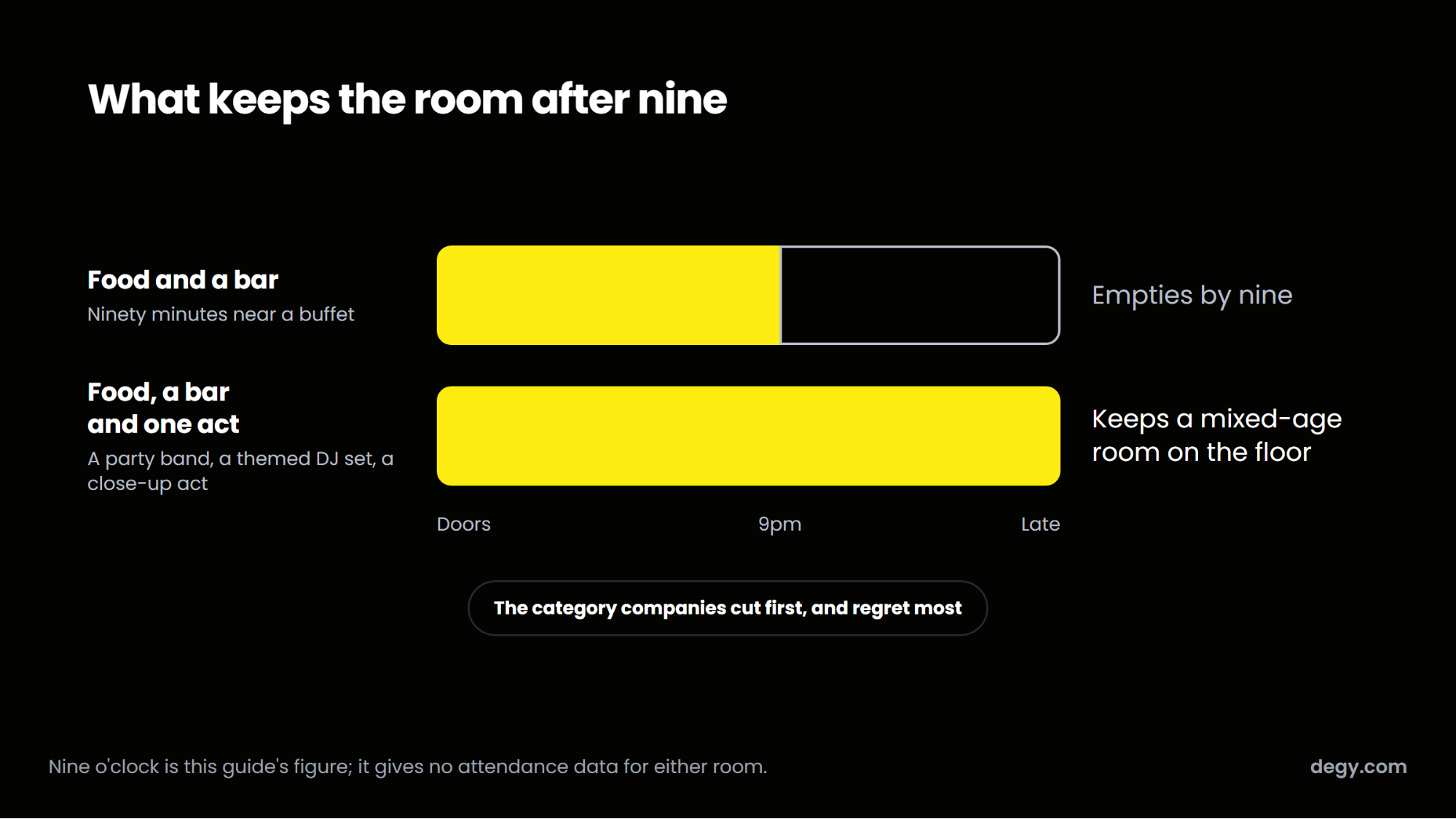
16. Cover band or party band. The default for a reason. A tight six-piece playing across four decades keeps a mixed-age room on the floor.
17. Nineties or eighties dance party. A themed DJ set with staging and lighting rather than a person with a laptop. The production is what separates it from putting a playlist on, and it is the cheapest way to fill a floor.
18. Stand-up comedian. A clean, corporate-experienced comedian doing a tight 35 minutes. Vet the material properly; this is the booking that goes wrong most often.
19. Mentalist or close-up magician. Works the room between courses rather than from a stage, which suits venues with difficult sightlines.
20. Casino night. Rented tables, dealers, play chips and a prize draw. Gives people something to do together that is not dancing.
21. Whiskey or wine tasting. A guided tasting with a host who can actually teach. Our Written in Whiskey experience is built around exactly this, and it doubles as the evening's structure.
22. Silent disco. Two or three channels so the room self-selects by taste. It also solves the venue noise limit that kills a lot of December bookings.
23. Interactive paint or craft experience. A guided creative session everyone takes something home from. Our Paint U party runs this way, and the detail that matters in a rented venue is the one nobody asks about in advance: how long the room takes to clear afterwards.
24. Live caricature or portrait artist. Low cost, continuous, and it produces the one thing people keep from a work party.
Matching the act to the room and the crowd is most of the job, and the options are wider than most planners assume; we walk through the main ones in five types of corporate entertainment.
Ideas for Remote and Hybrid Teams
Virtual parties have a bad reputation because most of them are a video call with a theme. The ones that work give people something to do and keep it short.
Against the hour that a screen will hold, a ballroom-length program is three times too long.
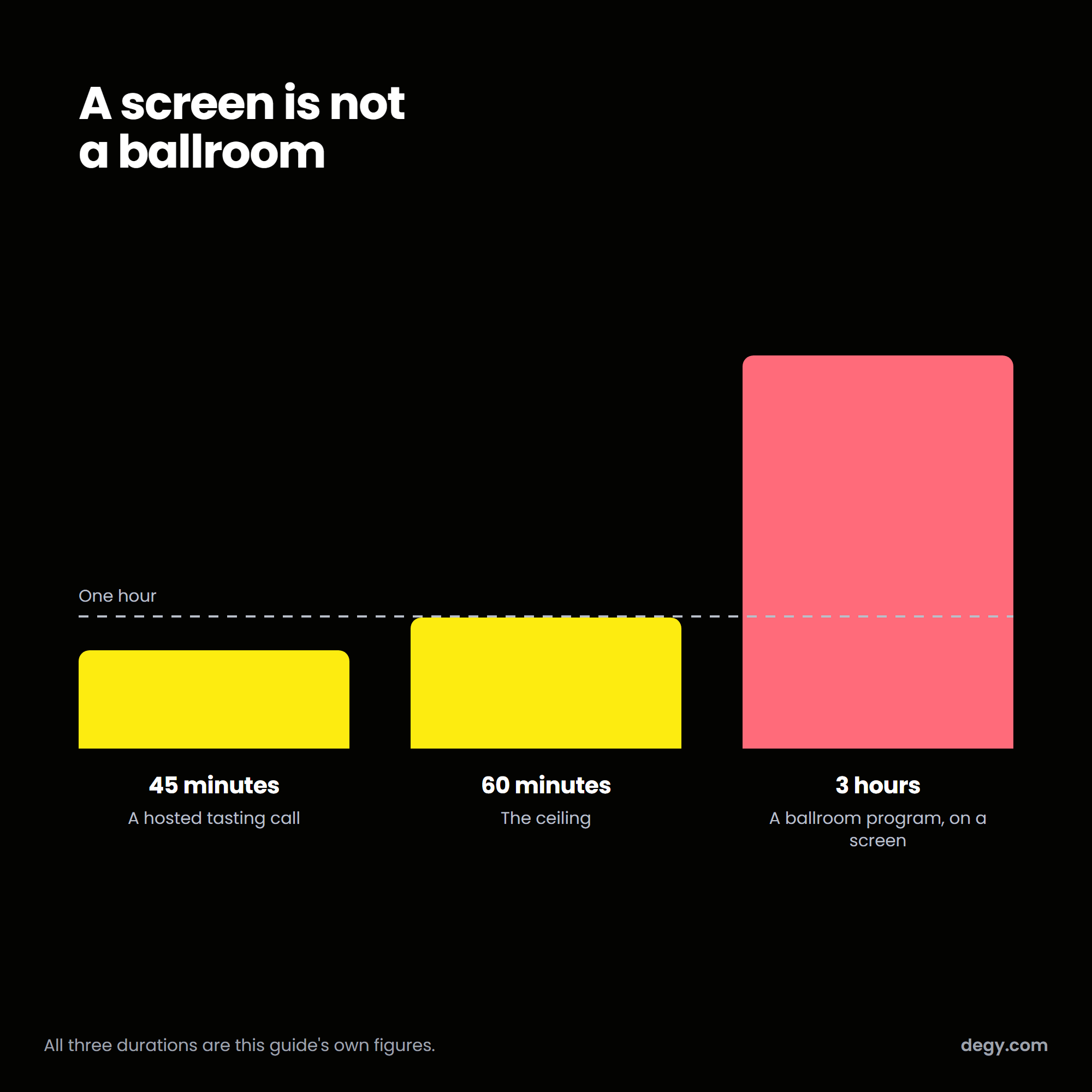
25. Shipped tasting kit with a live host. Wine, whiskey, cheese or chocolate delivered ahead, tasted together on a 45-minute call with a real host.
26. Virtual escape room. Small breakout teams, a clock, a facilitator. One of the few formats where an hour online passes quickly.
27. Online magic or mentalism show. Performed for camera by someone who does it professionally. It reads far better on video than a band does.
28. Cooking class from a shipped box. A chef, a set of ingredients, and everyone eats what they made.
29. Regional mini-parties with one live link. Each city holds its own dinner, all of them connect for fifteen minutes. Far better than one large call.
30. Stipend plus a shared hour. Give each employee a set amount to spend on their own meal, then meet for one short, well-run session.
Keep any virtual format under an hour. The failure mode is treating a screen like a ballroom and programming three hours for it.
How to Run a Party That Doesn't Become an HR Problem
A holiday party is a work event, and the employer carries the risk. SHRM's guidance on holiday-party liability is built around four considerations and is practical rather than alarmist. Every point in the list below is SHRM's rather than ours, condensed from that page.
- Hire a catering service that holds the appropriate licensing and insurance and supplies professional bartenders trained to handle alcohol-related issues. SHRM's attorneys make this their first recommendation, and it has the side benefit of making the party look better.
- Control the bar rather than banning it. SHRM suggests serving only beer and wine, keeping high-alcohol spirits off the menu, issuing drink tickets, and limiting the hours alcohol is served, then putting dessert and coffee out once the bar closes.
- Make attendance voluntary, and invite everyone. SHRM is explicit on both: attendance should be voluntary, and employees of every racial, religious and ethnic background should be encouraged to come.
- Arrange transport. SHRM's suggestion is a shuttle to public transit, or the company picking up the cost of taxis and ride-hailing.
- Say out loud that it is a work event where people are expected to behave professionally, brief leadership that they set the tone, and ask that incidents be reported immediately rather than weeks later.
Two things we would add from booking these parties rather than advising on them. Put the conduct line and the non-alcoholic options in the invitation itself, because one sentence there does more work than a policy document. And make the optional part explicit, since people have caring responsibilities, religious commitments and reasons of their own.
One more is neither SHRM's nor ours, and it is worth raising with your own counsel: if you make attendance mandatory, the time may be payable. Under the Labor Department's hours-worked rule, attendance stops being voluntary when the employer requires it, or when employees are led to believe that not turning up would count against them, which is what can put a mandatory party on the clock for hourly staff.
None of this makes the evening less enjoyable. It mostly makes it look like the company thought about it, which employees notice.
What a Holiday Party Costs Per Head
Deciding the per-head figure first collapses most of the arguments that follow, because every other choice is downstream of it.
Each range above is our planning guidance from booking corporate and private holiday events, not a published rate, and the figures move significantly by city. The figure that matters is not the total, it is what you protect when the budget gets trimmed in November.
Alternatives to a December Party
Some of the best decisions here are to not hold a December party at all. Company holiday parties are a convention rather than a requirement, and the alternatives often rate better.
Moving the same evening into January changes three things at once.
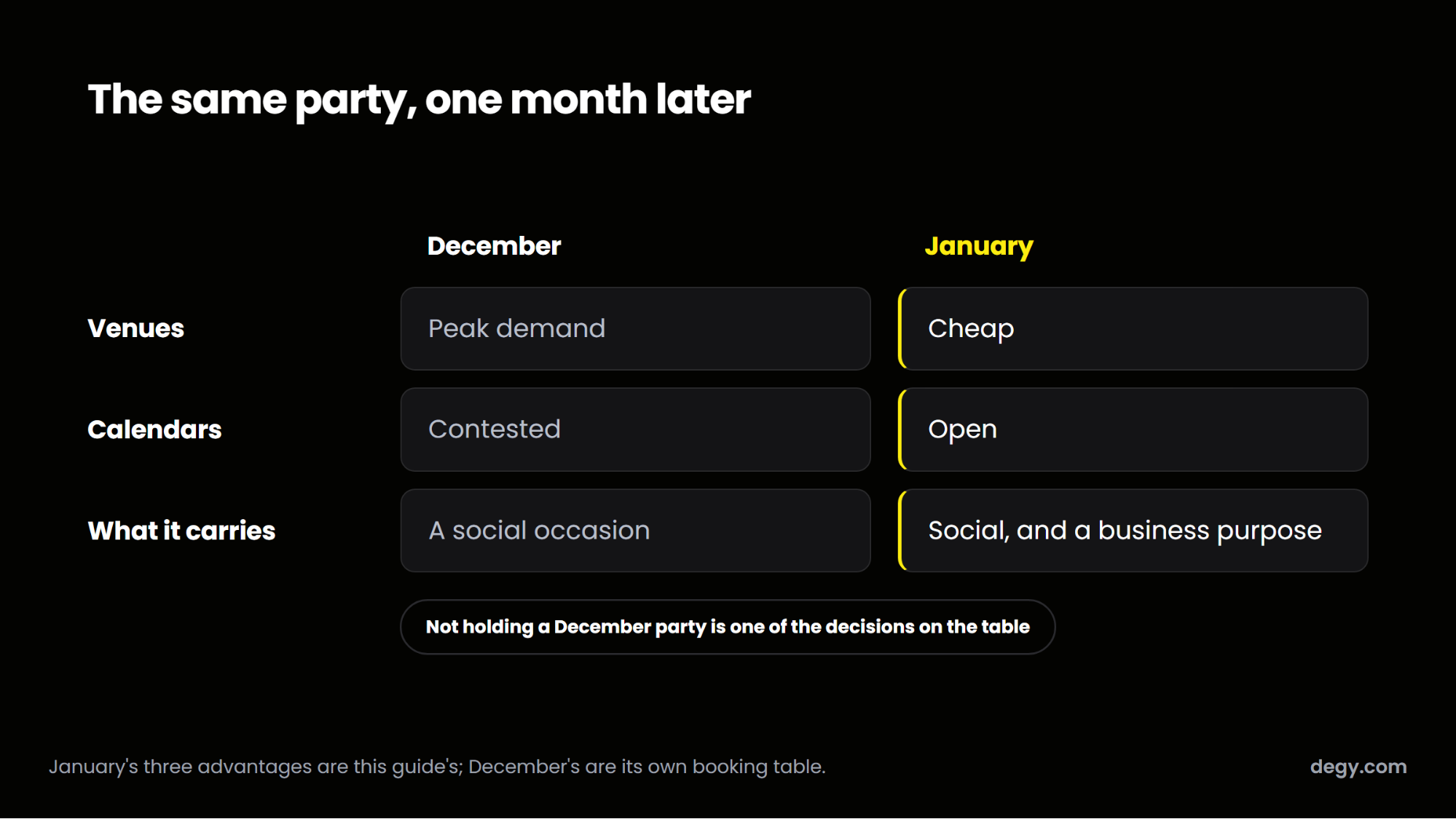
31. January kickoff party. Venues are cheap, calendars are open, and the event carries a business purpose as well as a social one.
32. Summer family day. Moves the celebration to a time when people can bring children and nobody is exhausted.
33. Team experience budget. Each team gets a per-head amount and chooses its own outing across the quarter.
34. Volunteering day with a meal. A shared afternoon of work followed by dinner. The teams we book this for tend to rate it well, though we have no survey data to put behind that.
35. Bonus instead of a party. Worth saying out loud: if the team would rather have the money, ask them. Some will, and the ones who would not will tell you what they want instead.
The honest version of this list is that the format matters less than whether people feel the company put thought into it. A well-run lunch says that. A grudging ballroom does not, and live entertainment is usually what decides which of the two an evening becomes.
Where We Fit
Degy Entertainment has been booking corporate and private entertainment since 2001, and December is the month where the gap between planning early and planning late is most expensive. We hold an exclusive roster built for this kind of room, plus turnkey experiences including Written in Whiskey and Miss Savannah Belle's Southern Stomp that arrive as complete productions rather than as a performer and a list of requirements.
Most of what we do on a holiday booking is unglamorous and decisive: confirming the act fits the room, that the venue's noise limit will not cut the set short, and that the contract says who covers what if the date moves. That work is the same whether the party is forty people or four hundred, which is why we handle it across corporate events of every size.
If December is still open and you would rather not be choosing from what is left in November, tell us about your event.
FAQs
How much should a company holiday party cost per person?
Most corporate holiday parties land between $45 and $150 a head all in, and the per-head table above shows what each band buys.
Set that figure before choosing a venue, because every other decision follows from it, and decide in advance which line you will protect if the budget is trimmed in November.
When should we book a company holiday party?
Between March and September for a December date, and ideally before Labor Day. Booking early buys choice rather than a discount, which is the part most planners get backwards: the price of a late booking is usually a worse date, not a bigger invoice.
What entertainment works best at a corporate holiday party?
Match it to the room rather than to taste: a party band for a mixed-age crowd, a themed DJ set for a younger team, a close-up performer where the sightlines are awkward.
The one booking to vet properly is a comedian, because material that works in a club can land badly in front of someone's manager. Ask for recent corporate references, not a highlight reel.
Should we serve alcohol at the company holiday party?
It is a legitimate choice either way, and the risk is manageable rather than disqualifying. SHRM's recommendations are set out in full earlier on this page, and the short version is a properly licensed caterer with trained bartenders, a controlled bar rather than a banned one, and transport arranged in advance. If you decide against alcohol, a lunchtime event is the easiest way to make that read as a format choice rather than a restriction.
What can we do instead of a holiday party?
A January kickoff is the strongest alternative, for the reasons set out above, and the five options in that section cover the rest.
Whichever you choose, announce it as a decision rather than as a downgrade. An alternative presented as a cut reads as a cut, however good the event turns out to be.