40 Corporate Event Ideas Employees Actually Enjoy
Key takeaways:
- Pick the goal before the activity. "Team building" is not a goal, and events booked without one are the ones people quietly resent.
- Hold it during working hours. Asking staff to give up an evening is the fastest way to turn a reward into an obligation.
- Budget per head, not per event. Four of the five formats below land between $25 and $250 a head, with entertainment-led evenings running above that, and the format drives the number far more than the headcount does.
- An event will not fix disengagement. Gallup puts global employee engagement at 20%, and a party does not move that, though a badly chosen one can make it worse.
What separates a corporate event people are glad to attend from one they quietly work around is usually settled before anything is booked, by whether anyone wrote down what the event is for. Get that part right and the activity almost picks itself.
The corporate event ideas below are grouped by what the event is for rather than by activity type, because purpose is what actually determines whether people show up willingly to company events.
Every entry states the three things that settle whether it is viable for you: an approximate per-head cost, the lead time it needs, and the demands it places on the room. Every dollar figure here is a planning estimate drawn from events we scope and book in US metro areas, not a quote or a survey benchmark.
Start With the Goal, Not the Activity
The most useful thing we have read on this came from somebody pushing back on the question itself. In a thread on r/corporate, an event planner asked for team-building suggestions and one reply refused to give any: "How many people? And what is the purpose? Do not say team building. Break down silos between different roles? Make managers more accessible? What would you like to improve?"
That is one comment on one thread, so treat it as anecdote rather than evidence. But it matches what happens on planning calls, where the question "what do you want to be different on Monday?" reliably produces a better event than a list of venues.
Three blanks on the brief decide the format: how many people, what should be different afterwards, and what the room has to allow. "Team building" fills none of them.

Scheduling is the other thing to settle before the format. An event held on personal time reads as unpaid work no matter how good the catering is, which is why almost everything below assumes working hours.
| If the goal is… | Pick a format that… | Avoid |
|---|---|---|
| Rewarding a finished push | Requires nothing from attendees | Anything with a facilitator |
| Connecting people who never meet | Mixes seating and forces small groups | Theater-style seating, big rooms |
| Making leadership approachable | Puts leaders in the same activity, not on a stage | A Q&A panel |
| Marking a milestone | Is bigger than a normal week | A slightly nicer lunch |
| Welcoming new hires | Has a low social cost of entry | Anything competitive |
Match the format to the row, and most of the usual complaints disappear before you have booked anything. Fun corporate events are rarely the ones with the biggest budget; they are the ones where the format matched the reason for gathering.
What Corporate Event Ideas Cost Per Head
Budget conversations go wrong when they start from a total. A $20,000 budget means something very different for 40 people than for 400, and the format is what has to change.
| Format | Typical range per head | Notes |
|---|---|---|
| Catered lunch on site | $25 to $45 | Cheapest way to get everyone in a room |
| Activity outing, local | $45 to $95 | Add transport if the venue is not walkable |
| Evening reception with bar | $85 to $150 | Bar is the variable, not the food |
| Half-day offsite with venue hire | $120 to $250 | Room hire and AV usually exceed catering |
| Entertainment-led evening | $150 to $400+ | Driven almost entirely by the act's fee |
Treat those as planning ranges we use when scoping events rather than as survey figures or quotes, and assume a US metro area. Most corporate event ideas can be built at two or three points on that scale, which is why the format matters more than the headline budget. A December holiday party is the clearest case, since the same guest list can be served by a catered lunch or an entertainment-led evening at four times the cost.
Within any one format the per-head figure barely moves with headcount, which is why the format is the real decision and the guest count mostly is not.

Two lines move more than people expect. Bar is the variable in any evening format, because consumption per head varies far more than food does. And on any offsite, room hire plus audio-visual routinely exceeds the catering bill, which is the opposite of what most first-time budgets assume.
Team Building That Does Not Feel Forced
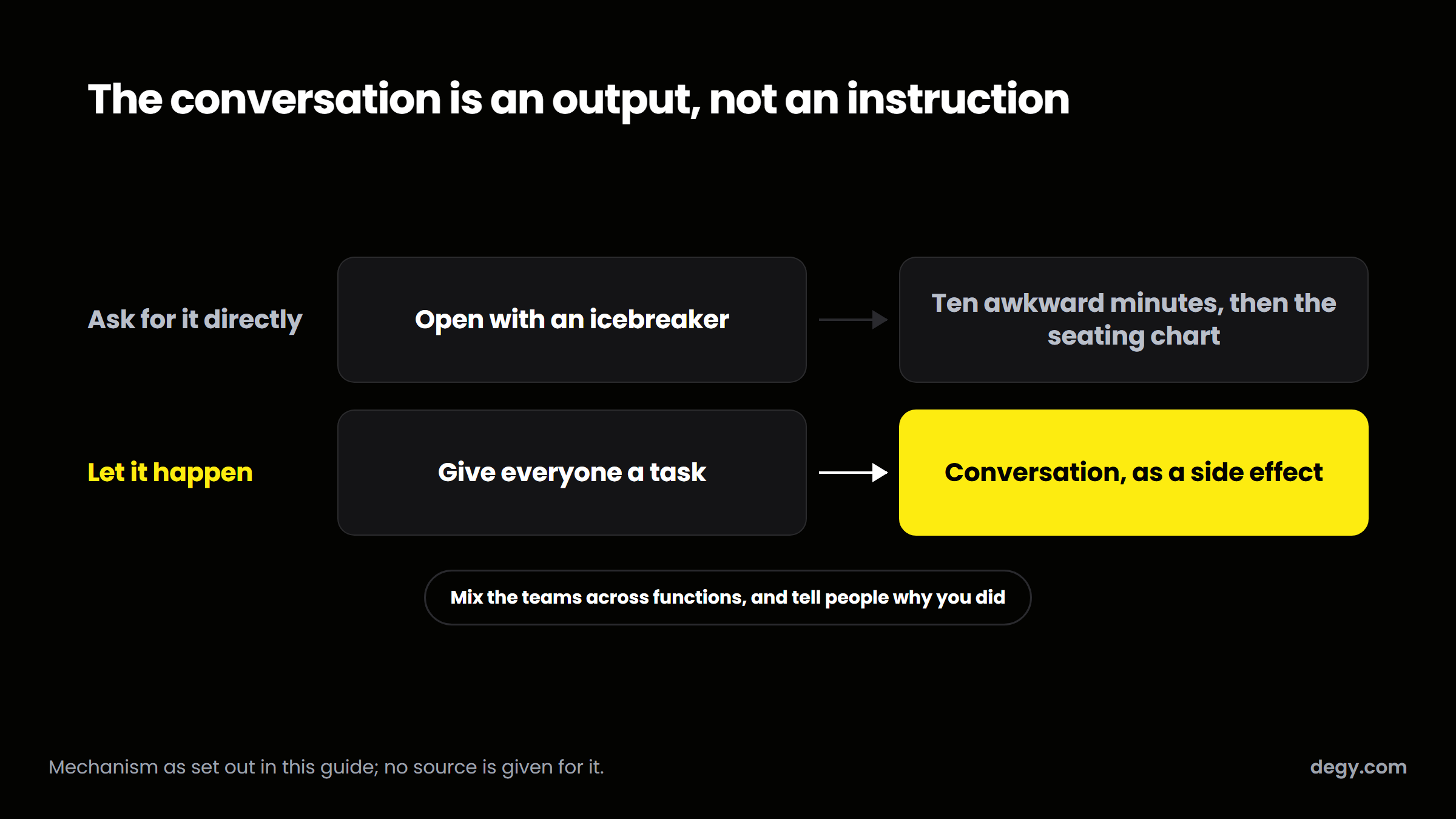
The rule for this group is that the activity should produce conversation as a side effect rather than demand it directly.
The quickest way to tell the two apart is to ask whether the activity still has a point if nobody talks. Where it does, people talk anyway.
Cooking class with a shared meal at the end. Groups of 8 to 30 work best, at roughly $90 to $140 a head for two to three hours including the food. Book four to six weeks out. The reason it works is that the awkward part is over in ten minutes because everyone has a task.
Escape room, split into competing teams. About $35 to $50 a head, 60 minutes, and most venues cap rooms at 6 to 8 people, so a group of 40 needs a venue with several rooms running simultaneously. Book three weeks ahead for a weekday afternoon.
Topgolf or a driving range bay. Around $50 to $85 a head for two hours with food. Works because it accommodates people who are good at it and people who have never held a club, which most competitive activities do not.
Go-kart racing or axe throwing. Roughly $45 to $75 a head. Both give quieter people something to do with their hands, which is usually why they get remembered. Check your insurance position first, since some employers exclude these.
A local walking food tour. $70 to $110 a head for two to three hours. Strongest option for a group under 25 with mixed physical ability, and it removes the "what do I do with my hands" problem entirely.
Trivia hosted by a professional. $600 to $1,500 for the host plus venue and catering, so on 60 people it lands near $40 a head all in. The host matters more than the questions; an experienced one manages the room, a volunteer colleague usually cannot.
A build challenge with a donated outcome. Teams assemble bikes, care packages or STEM kits that go to a local charity. Around $60 to $120 a head depending on what gets built. It is the one competitive format that rarely generates complaints, because the output is not the point.
Several of these can be run in house if you have somebody willing to own the logistics, and the rest are worth sourcing through a specialist, a split we have worked through in our guide to team-building event services.
How to Run a Team Activity Without the Cringe
Three things separate an activity people enjoy from one they tolerate, and none of them is the activity.
- Put it inside the working day, starting no later than 2pm, and let people leave at their normal time.
- Do not open with an icebreaker. The activity is the icebreaker; a separate one signals that the next two hours will be facilitated.
- Mix the teams deliberately across functions, and tell people why you did, so nobody thinks it was random.
- Give an opt-out that costs nothing socially, such as a role helping run it, for the people who genuinely do not want to play.
- End it cleanly at a stated time rather than letting it trail off.
The opt-out is the one most organizers skip, and it is the one that determines whether the people who did not want to be there spend the afternoon resenting it.
Celebrations and Milestones
Milestone events justify a bigger spend because they are infrequent and they mark something real. These are the corporate event examples people still reference years later, which is the test worth applying before approving the budget.
Company anniversary evening. Budget $150 to $300 a head with a venue, food, bar and entertainment. Start planning six to nine months out for anything over 150 people, since good venues on a Friday go early.
Summer picnic or family day. $60 to $120 a head, and the number to watch is the plus-ones, which typically run 1.6 to 2.2 attendees per employee. Book the park permit or venue four to six months ahead. Programming for an age range from four to sixty-four is its own problem, and family-friendly entertainment is where most of these days succeed or fail.
Quarterly or annual awards night. $100 to $200 a head. The single biggest improvement is cutting the awards section to under 25 minutes and putting it before dinner rather than after.
End-of-project dinner for the team that shipped it. $80 to $150 a head for a private dining room, booked two to four weeks out. Keep it to the people who actually did the work, since diluting it removes the point.
Holiday party. $100 to $250 a head depending on venue and bar. Book by August for a December date in any major market. Bar spend and venue tier drive the range far more than the headcount does.
A milestone-number celebration. The 1,000th customer, the 100th employee, ten years in a market. Around $50 to $120 a head, and the advantage is that it can be scheduled when it is convenient rather than in December with everyone else.
Retirement or long-service send-off. $40 to $90 a head. Worth doing properly for anyone over ten years of service, and worth asking them first whether they want a public one.
Client and Partner Events
The rule changes here. These events are judged by whether the right people came, not by how many.
Work out who has to be in the room before you decide how big the room is.

Small-format dinner for 10 to 20 clients. $120 to $250 a head in a private room. More valuable than a 200-person reception for most B2B businesses, and far cheaper.
Product launch with a demo and a reception. $80 to $180 a head. Budget for the room to work as both a demo space and a social space, which usually means more AV and more floor space per person than a plain reception.
Stadium suite or box for a game. $200 to $600 a head depending on market and matchup. Books a full season ahead for anything desirable.
An industry breakfast briefing. $35 to $60 a head, 7:30am to 9:30am, and attendance rates are higher than for evening events because it does not compete with family time.
A partner or channel appreciation evening. $100 to $200 a head. Pair it with an existing industry conference so travel is already paid for by someone else.
A customer advisory session with dinner attached. $150 to $250 a head for 12 to 25 people. The dinner is what gets the acceptance rate up on the session.
Entertainment-Led Evenings
When the entertainment is the reason people come, it becomes the first decision rather than the last, because it sets the room, the schedule and the budget. The corporate entertainment ideas here are ordered from lowest to highest production burden rather than by cost.
A private concert. The act's fee is the budget, and it is usually a long way below what people assume, particularly for a regional act with a real following rather than a name from the radio. Add production on top, which for a small room runs roughly $3,000 to $12,000. Narrowing down what kind of act suits the evening is the first decision, and there are five formats that cover most corporate rooms.
A comedian for an awards night or dinner. Most corporate-appropriate comedians sit in the $5,000 to $25,000 range. Jasmine Ellis is one of ours: a nationally touring comedian on our exclusive roster with three specials on SiriusXM and a credit on HBO's Last Week Tonight, who works corporate rooms as well as clubs. Brief whoever you book on what cannot be joked about, and do it in writing.
A mentalist or close-up magician working the room. $2,500 to $8,000 for two hours. Eric Dittelman, a mentalist on our exclusive roster, combines mind reading with stand-up and improv and currently appears in the off-Broadway show Speakeasy Magick. The act works during a reception in a way a stage act does not, because it moves to the guests instead of requiring them to sit down.
A dueling pianos or request-driven band. $4,000 to $15,000. The format's advantage is that it responds to the room, so it works across a wide age range.
A silent disco. Headphone rental runs roughly $12 to $25 a head plus DJs. The practical benefit is noise: it lets you run a late party in a venue with a sound restriction or a hotel with rooms above.
An interactive experience rather than a stage act. Degy Concepts builds turnkey formats like Mission Masterpiece, an immersive paint-and-sip, that give guests something to do rather than watch. These typically price per head rather than as a flat fee, which makes them easier to scale to an unknown final headcount.
How to Brief an Entertainment Booking
The brief determines the quote, and a vague brief produces a high one because the agent is pricing your uncertainty.
- State the date, city, venue and indoor or outdoor, because travel and weather contingency are real line items.
- Give the headcount and the room's capacity, which decide the sound and staging requirement.
- Say what the audience is: age spread, whether alcohol is served, whether partners and children attend.
- Name the performance length and the slot, since a 45-minute set after dinner is a different booking from three hours of background music.
- Give a budget range. Holding it back will not drive the quote down; it just produces proposals nobody can use.
- Say what is already in the room. An existing PA, stage or lighting rig materially changes the production cost.
Send all six in the first email. At Degy Entertainment the difference between a brief with these and one without is usually a week of back-and-forth, and a week matters when the good dates are going.
Wellness, Learning and Volunteering
This group has the best attendance economics because the activity has value to the attendee independent of the company.
The test is whether anyone would go if the company were not paying. Where the answer is yes, attendance looks after itself.

A volunteer day with a local organization. $20 to $60 a head for transport and food, with the day itself usually free. In that same Reddit thread, volunteering was the format people spoke about most warmly, because it lets people bring more of themselves than a game does.
A skills workshop taught by an outside expert. $60 to $150 a head. Choose something genuinely outside work, such as photography or negotiation, rather than a disguised training session.
An organizational psychologist or researcher speaking on how teams work. $3,000 to $15,000 for a speaker. A useful corrective to the assumption that people only ever want fun, provided you book a researcher rather than a motivational act.
A wellness half-day. $70 to $140 a head. Works best when it is genuinely optional and offers three or four parallel options rather than one mandatory activity.
A STEM or science fair volunteering session at a local school. $25 to $50 a head. Needs six to eight weeks of lead time to coordinate with the school's calendar.
A blood drive or health screening on site. Often free to host through a regional provider, needing only space and scheduling. Low cost, high goodwill, and it takes people away from their desks for 30 minutes rather than a day.
Small-Budget and Short-Notice Ideas
Every one of these can be organized in under two weeks for under $50 a head.
The cheapest corporate event ideas on this page are in this group, and several outperform formats costing ten times as much.
A catered lunch with the office closed for the hour. $25 to $45 a head. The closure is what makes it an event rather than free food.
An afternoon off, announced that morning. Free, and consistently the answer people give when asked what they actually want. It needs no booking and no venue, which is also why it gets overlooked.
A coffee cart or ice cream truck for an afternoon. $600 to $1,800 for two to three hours, which on 80 people is under $25 a head.
A board game and pizza afternoon. $20 to $35 a head. Low social cost of entry, which makes it a good format for teams with new hires.
A ping pong or pool tournament run over a week. Under $500 total if the equipment exists. Spreading it across a week means nobody has to clear an afternoon.
A team lunch budget given to managers to spend as they choose. $30 to $50 a head. Devolving it removes the central planning problem entirely and usually produces better results.
A photo or bake-off competition with a real prize. Under $300. The prize has to be worth wanting or it reads as a token.
A group outing to a matinee or local event. $25 to $60 a head. Booking a weekday matinee is roughly half the evening price for the same thing.
Working within a genuinely tight number is a skill rather than a compromise, and most of it comes down to spending on the one element people will remember and refusing to spread the rest evenly. We have set out that approach for a small corporate budget in more detail.
What an Event Can and Cannot Fix
Being honest about the limits matters here, because events are routinely asked to solve problems they cannot touch.
Gallup's State of the Global Workplace puts global employee engagement at 20%, down from its 2022 peak of 23%, and estimates that low engagement costs the world economy around $10 trillion, roughly 9% of GDP. Manager engagement specifically fell from 27% to 22% between 2024 and 2025. No event moves numbers like those, and any proposal that claims it will is overselling.
What events can do is narrower and still worth paying for. In a February 2023 survey of US workers, Pew Research Center found that 68% of women and 62% of men report having at least one close friend at work, and those relationships form through repeated informal contact rather than through structured exercises. Events that create unforced contact between people who do not otherwise meet are doing real work.
Jacqueline Weber at Saint Louis University described our team as "educators AND entertainment professionals," and that split is the useful frame here too. The event is the entertainment; whether anything changes on Monday depends on decisions made long before the booking. The case for booking live acts rests on morale and culture rather than on engagement metrics, and it is a more modest claim that happens to be true.
FAQs
How much should we budget per person for a corporate event?
Catered lunches start around $25 and most formats top out near $250, with entertainment-led evenings the exception at $150 to $400 and up, because the act's fee sets the number. Work out the format first and multiply, rather than starting from a total and trying to make it stretch. Bar is the line that moves most within a format, and venue hire plus AV usually exceeds catering on any offsite.
What is the best corporate event for a team that does not like team building?
Something with a genuine purpose outside the team itself, such as a volunteer day or a skills workshop taught by an outside expert. These work because attending is not an admission that you need help bonding, and people who dislike structured activities can participate without performing enthusiasm.
How far in advance should we book a corporate event?
Two weeks for a catered lunch or an office activity, four to six weeks for an activity venue, three to six months for a large evening event with a venue and entertainment, and by August for any December holiday party. The binding constraint is almost always the venue or the act's calendar rather than your own planning time.
Should corporate events happen during work hours?
Yes, wherever it is possible. Events held on personal time are experienced as unpaid obligations regardless of quality, which is the single most consistent complaint employees make about them. If an evening is unavoidable, such as an awards dinner, compensate with time back rather than assuming the event counts as the reward.
What are good conference entertainment ideas?
Keep it short and schedule it against the agenda rather than after it. A 20-minute mentalist or a house band during the evening reception works far better than a headline act competing with a day of sessions, and it costs a fraction as much. For multi-day conferences, one properly produced evening beats entertainment spread thinly across every night.
Choosing between a format that is fun and one that fits the goal is the hard part, and it is easier with someone who has watched how each one lands. Degy Entertainment works nearly 3,000 events a year in 30 countries, which is a lot of rooms to learn from. Every act on our exclusive roster publishes a fee band on its own page, so you can size the entertainment line before anyone quotes you.
The rest of what we do for corporate clients sits behind that same starting point: the goal first, then the format, then the act.
Whether you need a full evening built or a single act that suits the room, tell us about your event.