How Much Does a DJ Cost for a Corporate or Campus Event?
Key takeaways:
- Most working event DJs sit between $500 and $3,000. Of the 16 DJs on our own exclusive roster, 13 top out at $3,000 or less and 13 open at $500, and every one of the 16 tops out at $10,000 or less.
- Headliner DJ money is a different market. Across the 287 DJs in our major-acts catalog that publish a fee range, the median published ceiling is $15,000 and 90.9% top out at $50,000 or less.
- The DJ's fee is often not the largest line. On an outdoor event for 1,000 people, sound, stage and lighting routinely cost more than the DJ does.
- Music licensing is a real cost and the nonprofit exemption almost certainly does not apply to you. Federal law withdraws it the moment anyone is paid for the performance.
Search for DJ cost and every answer you get is about a wedding. The first page is wedding marketplaces, wedding vendor profiles and wedding forums, which is useful if you are getting married and much less so if you are booking the fall concert, the sales kickoff or the alumni weekend.
Corporate and campus DJ pricing works differently, and the differences are specific: different hours, different room sizes, different sound requirements, different procurement rules, and a music licensing position that varies with who owns the venue. This guide covers what a DJ actually costs for those events, using published fee ranges rather than a national average.
A DJ is also one option among several, and the cost logic here applies across entertainment formats for corporate events rather than to DJs alone. What changes between them is the size of the production bill attached, and DJ rates happen to be the easiest of the set to check against published figures.
What a DJ Actually Costs, by Tier
Almost every act in our catalog publishes a fee range on its own page, which makes DJ pricing unusually checkable in a category where most of it is quoted privately. The tiers below are how those published ranges group in practice, combining what our own acts list with the brackets we scope against for everything else.
| Tier | Typical range | What you are getting |
|---|---|---|
| Local working DJ | $500 to $1,500 | One operator, own controller, small PA, no lighting |
| Professional event DJ | $1,500 to $3,500 | MC duties, backup gear, dance floor lighting, a planning call |
| Regional name | $3,500 to $10,000 | A draw in their own market, tech rider, often a tour manager |
| Touring or festival DJ | $10,000 to $50,000 | Advance, hospitality rider, production requirements |
| Headliner | $50,000 and up | Full production spec, travel party, terms negotiated act to buyer |
On our exclusive roster, the 153 acts for which we hold direct representation, all 16 DJs fall inside the first three rows. Thirteen of the 16 top out at $3,000 or less, thirteen open at $500, and the highest ceiling on the roster is $10,000.
The picture changes in the wider catalog of acts we can be retained to secure on a buyer's behalf. Of the 320 DJs listed there, 287 publish a fee range and 33 publish none.
Among those 287, the median published ceiling is $15,000. A total of 108 (37.6%) top out at $10,000 or less, 225 (78.4%) at $25,000 or less, and 261 (90.9%) at $50,000 or less. Only 12 have a ceiling above $100,000 and just 7 above $250,000, none exceeds $1,000,000, and the full span runs from $700 to $500,000.
Nine in ten of those published ceilings stop at $50,000 or less, so the headline figures at the top of the catalog describe a small minority of the acts in it.

Two cautions on reading those figures. They are the artist's fee, not what the event costs, and the sections below show why that gap is usually large. They are also ranges rather than quotes, because the number inside the range moves with date, market, hours and what the rider demands. Each act on our exclusive roster carries its own band on its own page.
Why a National Average DJ Cost Is Not a Quote
Set the distribution in the section above against a single national figure and the problem becomes clear. Those published ceilings cover nearly three orders of magnitude, so any average drawn across them lands in a gap where very few bookings actually sit.
The deeper reason is that a published band is not a price. The number inside it moves with the date, the market, the hours on site and what the rider asks for, which is exactly why acts publish a range rather than a rate.
On real inquiries that shows up as a spread of roughly three to one between two legitimate DJs in the same city, and almost all of it is scope rather than skill. One quote covers four hours with a controller and a pair of powered speakers. The other covers a full day on site, redundant wireless microphones, a planning call, and sound sized for the room.
Laid out item by item, that three-to-one gap is almost entirely extra hours, extra equipment and extra redundancy rather than a higher rate for the same work.
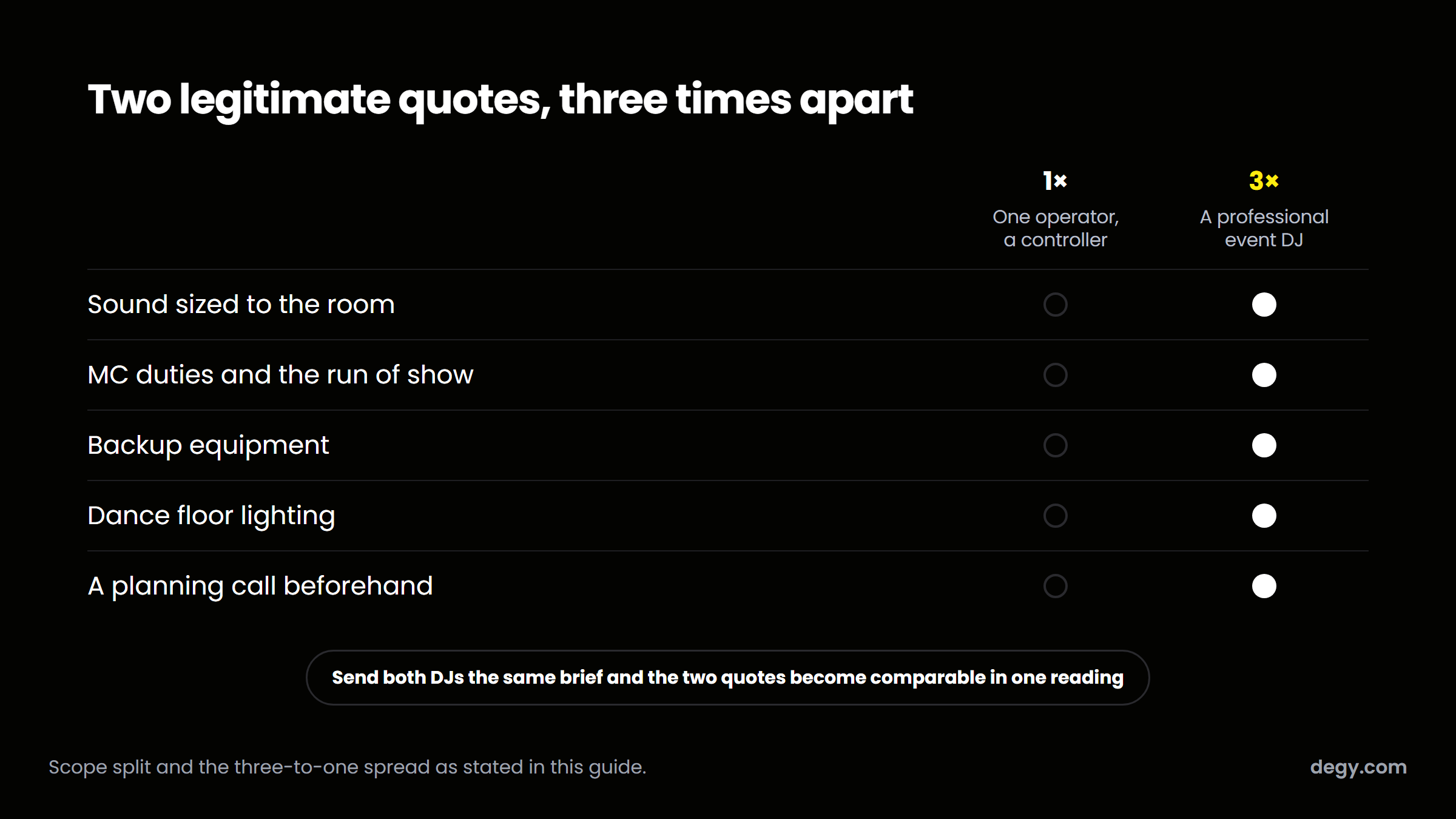
The same spread exists one step up the ladder, which is why choosing a band or a DJ on price alone rarely survives contact with the two quotes.
What Moves the Price
A DJ quote is not a rate card, it is a build. Once you can see the components, two quotes that looked incomparable usually turn out to be priced consistently for different amounts of work, and the DJ cost you were given starts to make sense.
| Factor | Effect on the fee | Why |
|---|---|---|
| Performance hours | Each hour past four adds roughly 15% to 25% | Overtime is usually contracted per hour or part hour |
| Total day length | Can double a four-hour fee | Load-in, soundcheck and standby are paid time |
| Sound system | $0 to several thousand | Small PA is often included; anything over 300 people is not |
| Lighting | $300 to $5,000 | Dance floor wash is cheap; stage lighting is a production line |
| MC duties | Adds 10% to 30% | Announcements, timeline management and running the room |
| Travel and lodging | $0 to $2,000+ | Anything over a two-hour drive typically triggers both |
| Date | Up to 40% | December Saturdays and spring campus weekends price at a premium |
Two of those rows account for most of the surprises. Total day length catches people because a DJ who performs for four hours may be on site for nine, and that is contracted time. Sound is the other one, and it is covered in its own section below because it is where corporate and campus events diverge most sharply from weddings.
The Five Things to Pin Down Before Comparing Quotes
Send the same brief to everyone and the quotes become comparable in a single reading.
- Headcount, room or site, and whether it is indoors or outdoors.
- The performance window and the full on-site window, stated separately.
- Whether the DJ is providing sound, and for how many people.
- Whether you need MC duties, and for which moments.
- Who is providing lighting, power and a table or riser.
Answering those five turns a vague inquiry into a scope, and a scope is the only thing a DJ can price accurately. It is the same discipline that makes an effective offer sheet work, applied earlier in the process.
Why Corporate and Campus Pricing Differs From Wedding Pricing
The wedding market sets the DJ price expectations most buyers arrive with, and it is the wrong reference for both corporate and campus work, in opposite directions.
Corporate events usually cost more than a wedding of the same size. The hours are often shorter, but the requirements are heavier: a professional PA that will carry speech clearly, redundant wireless microphones because an executive will speak, and insurance certificates naming both the venue and the client.
Procurement adds the rest: a W-9, net-30 or net-60 terms, and frequently a union or venue-preferred vendor rule that limits who can even bid. Every one of those requirements adds either cost or friction, and DJs price friction.
Campus events usually cost less per attendee and more in total. Student programming boards book bigger rooms and longer nights with smaller per-head budgets, which pushes the spend out of the DJ fee and into production. A campus DJ at $2,500 in front of 1,200 students typically sits inside a $15,000 production. Boards that work through block booking across colleges get a better rate on the act precisely because the travel is shared across several dates.
The other difference is procurement. A private couple decides in an evening. A campus board votes, a corporate buyer routes it through legal, and both take weeks. Holding a date costs the DJ real money, so a slow approval process either raises the fee or loses the act.
The Costs That Sit on Top of the DJ's Fee
This is the section that changes budgets. The DJ rates earlier in this article are what the artist is paid, and on anything larger than a function room they are a minority of the total event cost.
| Line | 200 people, indoors | 1,000 people, outdoors |
|---|---|---|
| DJ fee | $1,500 to $3,000 | $2,500 to $10,000 |
| Sound system and engineer | Usually included | $4,000 to $12,000 |
| Stage or riser | $0 to $500 | $2,000 to $6,000 |
| Lighting | $300 to $800 | $2,000 to $5,000 |
| Power and distribution | $0 | $500 to $3,000 |
| Travel and hospitality | $0 to $300 | $0 to $2,000 |
None of those figures is a survey result. They are the brackets we scope against in a US metro area, and a real quote lands somewhere inside them. The point of putting the two columns side by side is the ratio: indoors for 200, the DJ is most of the budget, and outdoors for 1,000, the DJ is roughly a fifth of it.
Outdoors for a thousand people, sound, staging and lighting each come to more than the DJ's own fee, which is what moves the act from most of the budget to roughly a fifth of it.

Budgeting from the fee alone is the most common reason an outdoor budget comes up short later on. Set the talent budget as a share of the total rather than as a number you arrived at first, because the production attached to the act decides whether the act is affordable.
Sound for the Room You Actually Have
The most common gap we see in a quote is sound for a room whose size never made it into the brief. A controller and two powered speakers will cover 150 people in a carpeted ballroom and will not cover 400 in a gym, and it will not cover any outdoor audience at all.
Above roughly 300 people, or anywhere outdoors, treat sound as a separate line with its own vendor and its own engineer. Give the DJ a spec to plug into rather than a problem to solve, and the fee usually drops, because you have removed the risk they were pricing.
Music Licensing, the Line Nobody Budgets
Playing recorded music in public is a licensed activity, and the license is the venue's or the organizer's responsibility, never the DJ's. Most hotels, arenas, student unions and municipal venues hold blanket licenses that cover your event. If yours does not, or if you are in a park, a parking lot or a rented tent, the cost lands on you.
The rates are published, and ASCAP has two separate 2026 schedules depending on how you license. Naming the right one matters, because they produce very different numbers.
If you license a season or a series, Exhibit A of ASCAP's 2026 rate schedule for covered festivals and events charges 0.3% of net revenue for a ticketed event, 1.5% of entertainment expense for a free one, and $59 per day for a qualifying benefit event, against a 2026 minimum fee of $310.
If you are licensing one event, which most corporate and campus bookings are, ASCAP's 2026 single-event schedule sets a flat fee by estimated attendance instead. Paid admission under 2,500 people is $429 with live music or $310 for recorded music only, rising to $822 with live music at 5,000 to 9,999. Free admission under 2,500 is $352 with live music, and benefit events deduct 25%.
The percentage schedule is worth working through where it applies. On a ticketed event with $200,000 of net revenue it comes to $600, so above roughly $103,000 of net revenue the formula drives the bill rather than the floor.
Below that line the minimum decides instead. On a free campus event with $12,000 of entertainment expense, 1.5% works out at $180, and ASCAP bills the $310 minimum.
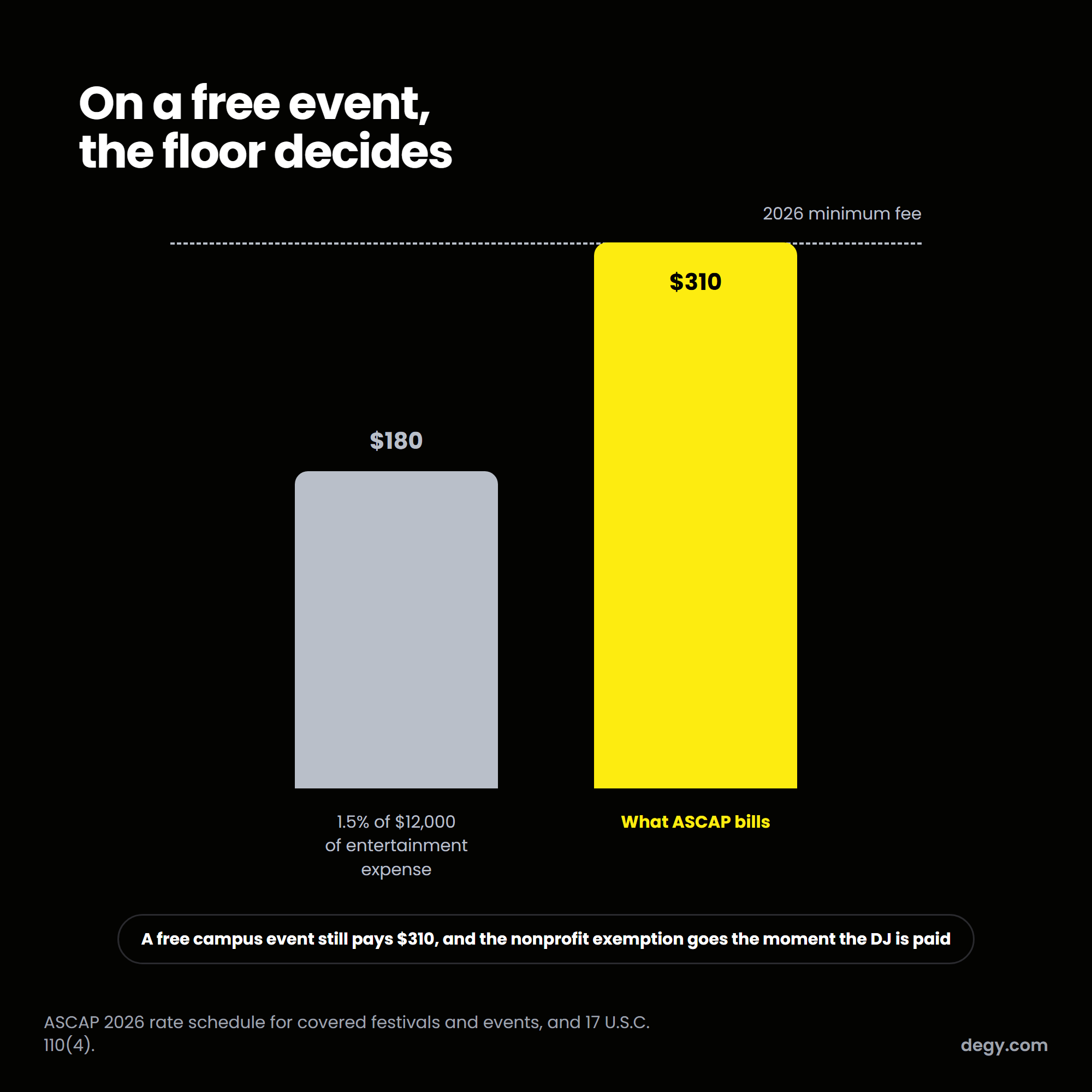
Now the part that catches nonprofits and student groups. Federal copyright law does contain an exemption for nonprofit performances, at 17 U.S.C. 110(4), and almost nobody reading this qualifies for it.
The statute exempts a performance only where there is "no payment of any fee or other compensation for the performance to any of its performers, promoters, or organizers," and where either there is no admission charge or the proceeds go exclusively to educational, religious or charitable purposes. Paying the DJ is payment for the performance. The exemption is gone.
The practical rule is short. Ask the venue for its license position in writing before you book, and if the answer is that it has none, add the licensing line to the budget rather than hoping. A copyright owner can also object in writing at least seven days before a performance, which is another reason the answer wants to be on paper.
Two caveats on everything in this section. ASCAP is one of several US performing rights organizations, so confirm which others your program needs and price each separately, and these schedules are reissued annually. None of this is legal advice: confirm the position with your venue, and where the sums or the liability are significant, with your own counsel.
When a Bigger Name Is Worth the Money
Multiplying the DJ cost from $3,000 to $30,000 buys one thing reliably, and it is not a better dance floor. It is an audience that was already coming for that name.
That makes it a marketing decision, not a talent decision. If the show is ticketed, or attendance is the metric you report on, a name with a real regional following can justify ten times the fee by filling the room.
The question that settles it is whether the room will be full either way, because a bigger name buys attendance and little else.

If attendance is guaranteed because it is a company party or a captive campus audience, the same money buys almost nothing a strong working DJ would not deliver, and it consumes the production budget that would have made the room feel better.
We work through this trade-off constantly, and the honest answer is usually the cheaper act plus better production. Weighing local talent against major talent is the same calculation whether the act is a DJ, a band or a comedian.
What to Send in Your First Email
Most confusion about DJ price resolves itself once the brief is specific. A short note with the right details gets you a number in a day rather than three rounds of questions.
Include the date and a backup date, the city, the venue type and headcount, both time windows from the list above, whether sound and lighting are covered, whether you need MC duties, your payment terms, and your actual budget range. Naming the range is not a weakness. It stops everyone wasting a week finding out you are $15,000 apart.
If you would rather not run that process five times, that is the part we do. Nearly 3,000 events a year across more than 30 countries, over twenty-five years of them, mostly amounts to knowing which questions change the number. Talk to our team and we will bring back DJ options at the level your budget actually supports, with the sound and licensing questions already answered.
FAQs
How much does a DJ cost per hour?
Hourly framing is misleading for event work, because most DJs quote a package for a performance window and then charge overtime per hour beyond it. A four-hour package at $2,000 is not $500 an hour, since it includes load-in, soundcheck and standby. Ask for the package price and the overtime rate separately.
What is a reasonable DJ price for a 200-person corporate party?
Plan on $1,500 to $3,000 for a professional event DJ covering four hours with MC duties, their own sound for that room size, and dance floor lighting. Add $300 to $800 if lighting is not included, and expect a premium of up to 40% for a December Saturday.
Do DJ rates include a sound system?
For an indoor audience under about 300, usually yes. Above that, or anywhere outdoors, usually no, and you should not want it to. Sound for 1,000 people outdoors is a $4,000 to $12,000 line with its own engineer, and if a DJ offers to cover it with their own rig, it is worth checking that the headcount reached them.
Does a campus or nonprofit event need a music license?
Almost certainly yes, and the common assumption that nonprofit status exempts you is wrong. The exemption in 17 U.S.C. 110(4) applies only when nobody is paid for the performance, so paying a DJ removes it. In practice most student unions and campus venues already hold blanket licenses, so the real task is getting that confirmed in writing before you book.
Why are DJ quotes for the same event so different?
Almost always scope rather than skill. Two quotes can differ by three times because one includes sound for the room, MC duties, backup equipment and a planning call while the other is one operator with a controller for four hours. Send every DJ an identical brief covering headcount, venue, hours on site and who supplies sound, and the quotes become comparable immediately.